
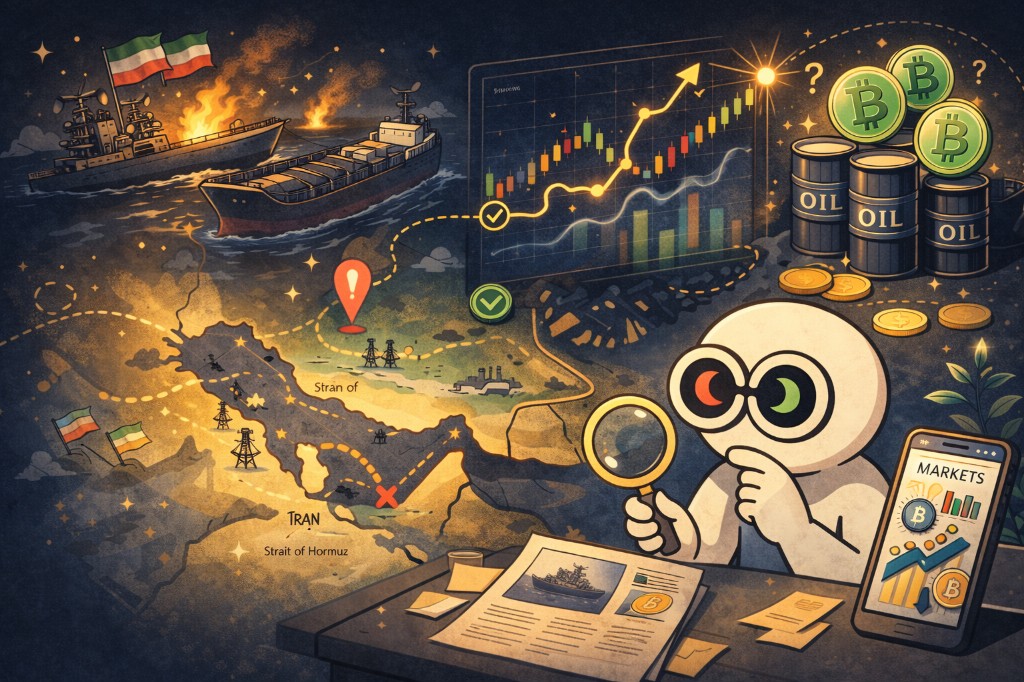
The Chain Reaction: One Strike, Five Markets
On March 15, 2026, the U.S. and Israel launched coordinated strikes on Iranian nuclear facilities. Within hours, the geopolitical shockwave rippled through every major asset class: crude oil surged past $85, the Strait of Hormuz shipping risk spiked, and Bitcoin entered a tug-of-war between risk-off selling and safe-haven narrative buying. But here's the thing: prediction markets on Polymarket and Kalshi had already shifted odds 6 hours before major media broke the story.
This article maps the full chain reaction — from Iran to Hormuz, from oil to Bitcoin — and shows how prediction market signals can give retail traders an actionable edge.
Hormuz: The $17 Trillion Chokepoint
The Strait of Hormuz is the most critical energy bottleneck on Earth. ~20% of global oil supply and ~25% of global LNG transits through this 33-mile waterway daily. Any credible disruption — even a partial naval blockade — creates an immediate structural supply shock that propagates through the entire commodity complex.
After the strikes, Polymarket's Hormuz-related contracts became the first real-time barometer of escalation risk. PreMind detected a sharp probability shift on "Will 20+ ships transit the Strait of Hormuz on any day in March?" — the NO side surged from 31% to 68%, signaling that smart money was pricing in significant disruption risk.
Crude oil jumped 8%+ in 48 hours as Hormuz disruption risk entered spot pricing. Prediction markets priced this move 6h early.
"Will 20+ ships transit Hormuz in March?" — NO surged to 68.5%, reflecting real disruption expectations.
Initial risk-off selling (-4%) followed by safe-haven buying. BTC's response depends on whether conflict escalates or de-escalates.
Energy stocks surged, airlines tanked, defense rallied. Prediction market odds led sector rotation by hours.
Japan imports 90% of oil via Hormuz. South Korea 70%. A prolonged closure would devastate Asian markets disproportionately.
Oil: Why Prediction Markets Led the Futures Market
Traditional oil traders rely on OPEC reports, inventory data, and analyst forecasts — all of which are backward-looking. Prediction markets, by contrast, aggregate forward-looking conviction backed by real capital. When institutional traders saw intelligence about the strikes before mainstream media coverage, they didn't call Bloomberg — they placed bets on Polymarket.
PreMind's AI engine detected the Trump "Hormuz Coalition" news signal — an article about a U.S. plan to control the Strait — and cross-referenced it with live Polymarket pricing. The result: a Buy NO signal with 5.5% edge on the shipping transit market, generated before the oil futures spike fully materialized.
Bitcoin: Safe Haven or Risk Asset?
The Iran crisis exposes Bitcoin's identity crisis in real time. In the first 12 hours after the strikes, BTC dropped 4% alongside equities — acting as a risk asset. But within 48 hours, narrative shifted: the "digital gold" thesis re-emerged as traders worried about petrodollar instability and potential sanctions on SWIFT alternatives.
Prediction markets like Polymarket now host contracts on ETH and BTC price targets for March 2026. These contracts became a real-time sentiment gauge: when the Hormuz risk spiked, the $2,400 ETH target saw a probability drop while the BTC $90K target held steady — revealing that the market viewed BTC as more resilient to geopolitical shocks than altcoins.
How PreMind Detected the Signal Chain
This crisis was a textbook example of PreMind's multi-layer signal architecture working in concert:
Layer 1 — AI News Analysis: PreMind's engine scanned 35+ news sources every 3 hours. The Iran strike headlines were captured from Asian RSS sources (NHK, SCMP) before Western media picked them up, thanks to our time-zone-aware news fetching.
Layer 2 — Market Matching: The AI automatically matched the Iran news to 3 Polymarket contracts: Hormuz shipping, crude oil targets, and Iran regime stability — generating actionable signals with confidence scores and edge calculations.
Layer 3 — Whale Confirmation: On the Whale Intelligence page, multiple large traders were spotted accumulating NO positions on Hormuz transit markets. PreMind aggregated these into a Consensus Card — showing 3 whales, all betting the same direction, totaling $180K+ in positions.
Layer 4 — Cross-Confirmation Boost: When both the AI news signal AND whale activity pointed in the same direction, PreMind's cross-confirmation system boosted the signal's confidence score — making it a high-priority alert pushed to Pro users via Telegram.
What Happens Next: Three Scenarios to Watch
Scenario 1 — Escalation (Hormuz blockade): Oil spikes to $100+, Asian equities crash, BTC initially sells off then rallies on safe-haven narrative. Monitor Polymarket's Hormuz contracts daily.
Scenario 2 — Controlled response (no Hormuz disruption): Oil premium fades within 1-2 weeks, BTC resumes macro trend. The opportunity shifts to fading the fear premium on oil contracts.
Scenario 3 — Diplomatic off-ramp: Fastest de-escalation. Oil gives back gains, Hormuz transit odds normalize. Early signal: watch for YES probability recovery on the shipping transit contracts.
Actionable Framework for Retail Traders
1. Don't trade the headline — trade the signal. By the time CNN reports the strike, the prediction market odds have already moved. Use PreMind AI Signals to catch the shift in real time.
2. Watch the Hormuz contracts as your macro compass. Hormuz disruption probability is the single best leading indicator for oil, Asian equities, and shipping stocks. It's more useful than any analyst report.
3. Use whale consensus for conviction. A single whale trade could be noise. Three whales building the same position is a signal. Check the Whale Consensus Cards for institutional conviction.
4. Cross-reference oil and crypto signals. When oil surges AND BTC holds, the safe-haven narrative is winning — consider long BTC. When both drop, it's pure risk-off — reduce exposure.
→ Monitor live Iran-Hormuz signals and cross-platform pricing on PreMind