
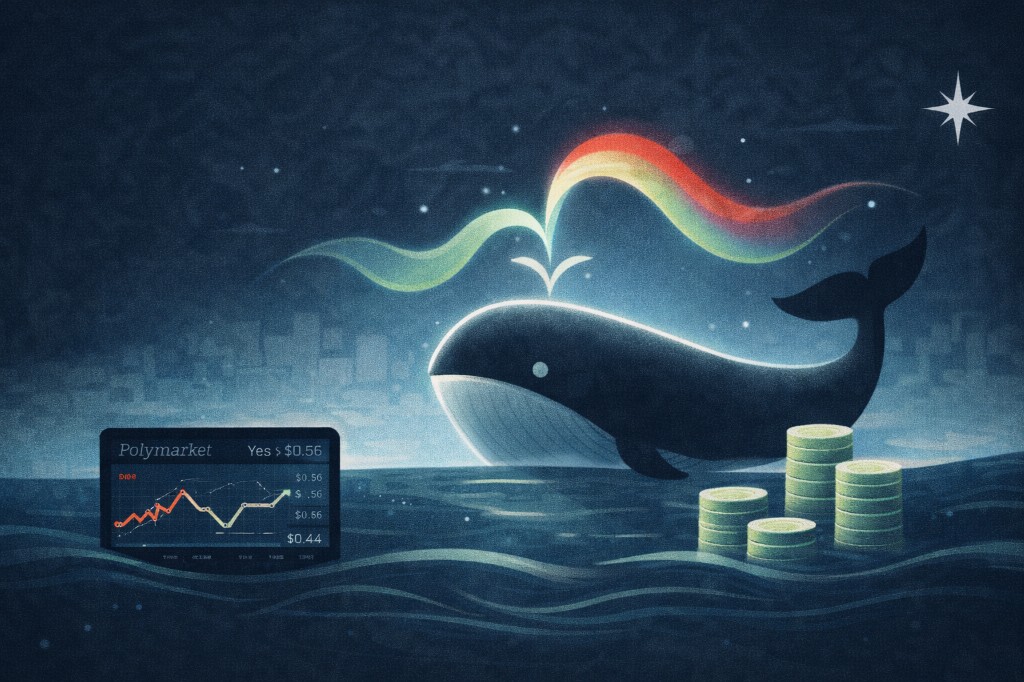
What Is a "Whale" in Prediction Markets?
In crypto, a whale is someone who holds enough assets to move the market. In prediction markets like Polymarket and Kalshi, the concept is the same—but instead of token prices, whales move probabilities.
A whale on Polymarket might place a $50,000 order on a single contract. That single order can shift the YES price from 42% to 49% in seconds. To ordinary retail traders, this looks like random noise. But to those who know how to read the signal, it's a roadmap.
Why Large Orders Predict Price Movements
Whales don't move their capital without reason. In prediction markets, large orders almost always fall into one of three categories:
1. Information-driven orders — The trader has non-public or hard-to-find information that makes them confident the market is mispriced. This is the most valuable type of whale signal to track.
2. Arbitrage orders — The trader spotted the same event trading at different prices across Polymarket and Kalshi, and is locking in a risk-free spread.
3. Liquidity-provision orders — Market makers placing limit orders at both sides. These are less directional but still signal where sophisticated capital thinks fair value lies.
The key insight: information-driven whale orders consistently precede price movements by minutes to hours. By the time retail traders see the headline, the edge is gone.
How to Identify a Meaningful Whale Signal
Not every large order is a useful signal. Here's what separates noise from alpha on Polymarket and Kalshi:
Size relative to liquidity: A $10,000 order in a $5M market barely moves the needle. But the same order in a $50K market is a 20% volume shock—a much stronger signal.
Speed of accumulation: A single large order can be an outlier. Multiple large orders in the same direction within a 30-minute window is a pattern. Premind's whale monitor tracks accumulation clusters, not just individual trades.
Cross-platform confirmation: When the same directional bet appears on both Polymarket and Kalshi within hours of each other, the signal strength multiplies. Two independent markets pricing the same event differently creates an arbitrage—and where arbitrage exists, smart money moves fast.
A Real Example: How Premind Detected a Pre-News Whale Move
Consider a geopolitical event where diplomatic negotiations were underway. At 2:00 AM, while most retail traders were asleep, Premind's whale monitor detected a sudden cluster of YES orders on a "ceasefire by end of month" contract on Polymarket. The YES price jumped from 18% to 31% in under 20 minutes—driven entirely by 4 large orders totaling $82,000.
Six hours later, a major news outlet broke the story of a breakthrough in negotiations. The YES price hit 68%. The traders who acted on Premind's whale alert had a 37-percentage-point head start on every retail trader who waited for the news.
This is the edge that Polymarket whale tracking provides—and it's available 24/7 through Premind.
Limits of Whale Tracking: What to Watch Out For
Whale signals are powerful but not infallible. There are scenarios where large orders are misleading:
Wash trading / market manipulation: A trader may inflate their own position to trigger stop-losses or attract followers, then reverse. Premind filters out repeated orders from the same wallet address.
Hedging positions: Some whales are hedging an off-market position, not making a directional prediction market bet. Cross-referencing with news signals helps distinguish the two.
Already-priced-in information: If the whale order happened 12 hours ago, the market has likely already absorbed the signal. Premind's real-time alerts prioritize freshness—signals older than 2 hours are deprioritized in the feed.
How Premind Combines Whale + News Signals
A whale order alone is a 60% signal. A whale order coinciding with a breaking news event is an 85%+ signal. Premind's intelligence layer cross-references:
📰 News synthesis — AI scans thousands of sources in milliseconds, tagging which events are likely to move specific markets
🐋 Whale order clustering — Large orders flagged across Polymarket and Kalshi, filtered by size, direction, and timing
⚡ Cross-platform divergence — When Kalshi and Polymarket price the same event differently, Premind highlights the gap as an arbitrage opportunity
The result: instead of chasing prices after the fact, you see the setup forming in real time. Explore the live signal dashboard on Premind →
Start Tracking Whale Signals Today
The next time you see a Polymarket contract move sharply without any obvious news, ask yourself: was a whale just here? With Premind's whale monitor, you don't have to guess. The data speaks for itself—and it speaks first.